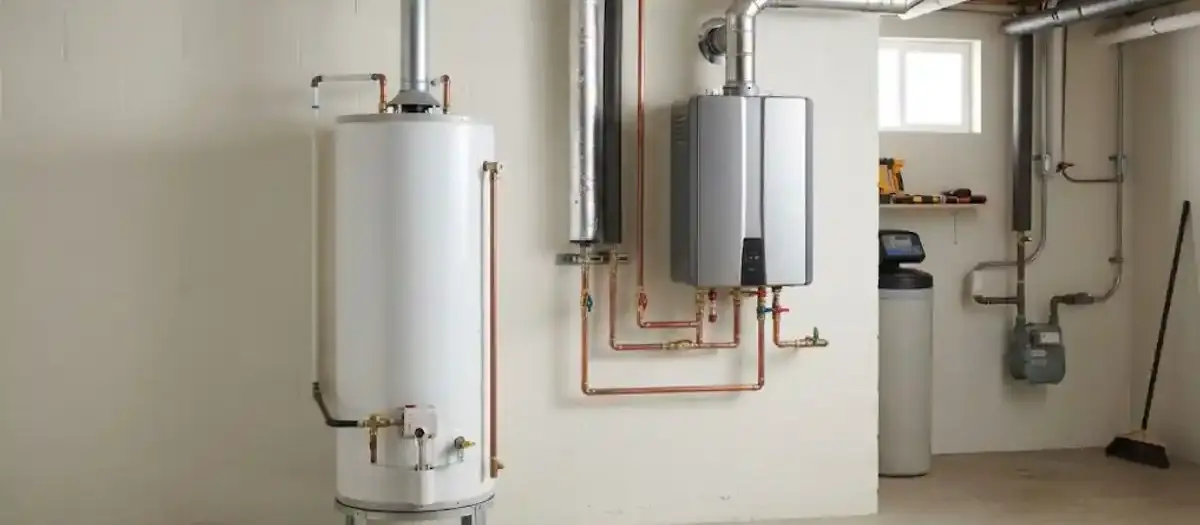
How a tankless unit differs from a tank
A tankless heater has no storage. When a tap opens, a flow sensor fires a burner or element and the water leaves hot. That removes standby heat loss and the risk of a tank flood, but it puts all the demand on one device at once.
If two showers and a washer run together, a unit that is too small will fall behind. We size by flow rate and temperature rise, not by tank gallons, and we check that your home has the gas supply or electrical capacity the unit needs. The maker's installation guidelines set the minimum gas supply and the approved vent materials, and the flush interval in the manual is the one we follow.
Tankless problems we fix
- Error code on the displayThe code points to ignition, flow, venting or sensor trouble. We read it before touching parts.
- Lukewarm water or temperature swingsScale on the heat exchanger or a clogged inlet filter is common.
- No hot water at low flowSome units need a minimum flow to fire, and a dirty filter reduces it.
- Noisy operationScale, a failing fan or a venting restriction can cause it.
- Cold sandwich effectWater already in the pipes between uses runs cold before hot arrives.
Tankless versus tank
| Question | Tankless | Tank. |
|---|---|---|
| Hot water supply | Continuous at rated flow | Limited by tank size. |
| Space | Wall mounted, small | Floor space needed. |
| Maintenance | Annual flush recommended | Periodic drain and anode check. |
| Failure mode | Error code, scale or ignition | Leak or rust-through. |
| Up-front cost | Higher | Lower. |
Flushing and descaling
Mineral scale builds on the heat exchanger over time and cuts flow and heat. Flushing runs a descaling solution through the unit in a loop and then rinses it. We also clean the inlet screen.
The Seacoast Utility Authority treats its water with nanofiltration and low-pressure reverse osmosis at its Hood Road plant. Its 2025 water quality report does not list a hardness figure, so we do not guess at scale rates. We look at your unit and recommend an interval from what we see.
Tankless unit showing a code?
Call and read us the code on the display. We will tell you the likely cause.
How a tankless visit runs
Read the unit
We check error history, flow rate and inlet screen.
Test the system
We verify gas supply or power, venting and condensate drain.
Service
We flush, replace parts or clear restrictions as needed.
Verify output
We measure temperature at fixtures and explain results.
Gas safety and venting
Gas tankless units need a sized gas line and a proper vent. A sticker on the unit lists the minimum gas supply it needs. If you smell gas around the unit, leave the house and call the gas utility or 911 from outside.
Condensing models drain acidic condensate, which needs a neutralizer or a safe drain. We check that drain during every service because a clogged condensate line shuts the unit down.
What affects tankless service cost
Service cost depends on the unit and what is wrong.
Questions we hear most
Yes. The 24/7 line at (561) 448-8545 is answered at all hours, and we dispatch a plumber the same day when a slot is open.
Once a year is a common manufacturer interval. We adjust it after inspecting your heat exchanger.
Codes point to ignition, flow, venting or sensor faults. The code and model number tell us what to check.
Often, yes, if your gas line and vent can support it. We confirm before quoting.
Most need electricity to run controls and fans. Ask about backup if outages are a concern.
Tank repairs are simpler for many parts. See water heater repair.