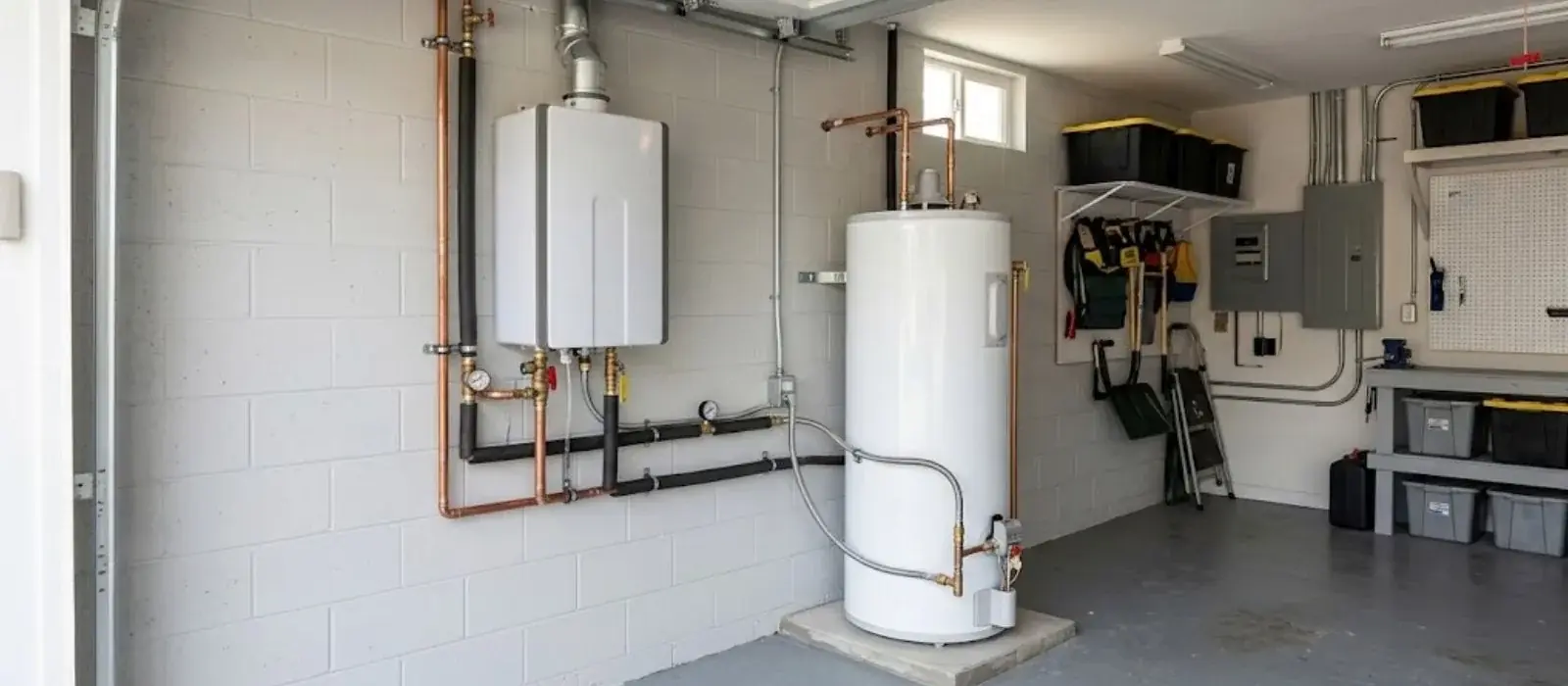
What changes when you go tankless
A storage tank has a small burner that heats a large volume slowly. A tankless unit has a large burner that heats a small volume instantly. That burner draws much more gas for short bursts, and the gas line, meter and regulator all have to keep up.
Your existing gas line may be too small. A sticker on the new unit lists the minimum supply, and we compare it with your line and meter before ordering. Model standards such as NFPA 54 cover gas piping and venting, and the maker's guidelines add the details for each unit.
What an install plan covers
- Gas supplyLine size, length and meter capacity decide whether the unit can fire at full rate.
- VentingMost units need special vent pipe, often stainless or PVC for condensing models, run to the outside.
- Condensate drainCondensing units produce acidic water that needs a neutralizer and a safe drain.
- Water linesIsolation valves allow flushing later.
- PowerThe unit needs an outlet for controls and a fan.
- PermitPermit rules vary, so check with the building division.
Gas and permits near you
The City of Palm Beach Gardens Building Division can be reached at 561-799-4210 and accepts permits through an online system. Its page states office hours of 8 a.m. to 4:30 p.m., Monday to Friday.
Permit rules vary, so ask the division whether a tankless gas install at your address needs one. Gas service in the city comes from Florida Public Utilities or TECO Peoples Gas depending on address, so confirm which one serves you.
We also dispatch to North Palm Beach, where gas service and permits come from different offices.
Source type: City of Palm Beach Gardens Building Division and emergency contacts pages.
Gas safety rules to follow
If you smell gas at any time, leave the house and call the gas utility or 911 from outside. Do not switch lights or devices. The city lists Florida Public Utilities at 561-832-0872 and TECO Peoples Gas at 877-832-6747 on its emergency contacts page.
We test gas connections for leaks after every install and check venting for proper draw. A correct install leaves no gas smell and no soot.
Tankless install versus tank swap
| Item | Tank swap | Tankless install. |
|---|---|---|
| Gas line | Usually reused | Often upsized. |
| Vent | Reused | Often new. |
| Drain | Relief line | Condensate and relief. |
| Time | Half day | Longer. |
| Permit | Check with the city | Check with the city. |
Is tankless worth it here
If you have a large family or hate running out of hot water, a tankless unit solves that. If you want the lowest up-front cost, a tank is cheaper. In a hurricane-prone area, remember that most tankless units need electricity to run.
See our tankless water heater page for maintenance, and compare with water heater installation if you are still choosing.
Maintenance after install
Flush the heat exchanger once a year or as the manufacturer advises. Clean the inlet screen. Check the vent and condensate drain. If the unit shows an error code, write it down and call.
Scale rate depends on your water. Since the utility report lists no hardness figure, a tap test tells you how aggressively to flush.
Questions to ask any installer
Ask whether they sized the gas line, whether the vent will be run to code, whether a condensate neutralizer is included and how permits are handled. A clear answer on each is a good sign. A vague answer on gas sizing is a reason to look elsewhere.
Cost drivers to expect
The unit itself is only part of the price. The largest swing items are usually a new gas line, new vent pipe and a condensate drain with a neutralizer. A house where the old tank sat next to a gas line and an exterior wall costs less to convert than one where the heater is in an interior closet.
Ask each installer for a written scope that lists the gas line work, the vent run, the drain and the permit handling. That lets you compare quotes line by line instead of by a single bottom number.
Questions to ask before you sign
- Who sizes the gas lineAsk what BTU load they used and how they confirmed the meter can supply it.
- What vent material is usedThe maker specifies approved vent materials for each model.
- Where does condensate goA clear answer prevents a clogged drain later.
- Is a flush valve kit includedIsolation valves make yearly flushing easy.
- What does the warranty requireMany makers require yearly service to keep coverage.
Make sure the unit suits how your household uses water
Ask how many fixtures run at once in a busy morning. If two showers and a dishwasher overlap, check the flow rating of the unit at the temperature rise you need. Some homes choose two smaller units instead of one large one.
A small family may be happy with a modest unit. A large one may regret a model chosen on price alone.
Quick answers
Often yes. The unit lists its gas demand and we compare it with your line.
Most cannot without backup power.
Longer than a tank swap because of gas and venting work.
Permit rules vary. Ask the Palm Beach Gardens Building Division at 561-799-4210.
Yes, after checking gas, venting and space.
The city lists both Florida Public Utilities and TECO Peoples Gas. Your gas bill names yours, and either utility can confirm it by phone.