The short answer on lifespan
A standard tank heater commonly runs eight to twelve years. A hybrid heat pump unit and a tankless unit often run longer when maintained, though they have more parts that can fail. Those figures are general industry ranges, not promises for any one tank.
The age printed on your tank is the starting point. The serial number usually encodes the month and year of manufacture, and the manufacturer's website can decode it. Manufacturer guidelines suggest flushing the tank yearly and testing the relief valve, and both habits help a tank reach the long end of its range.
Signs the tank is near the end
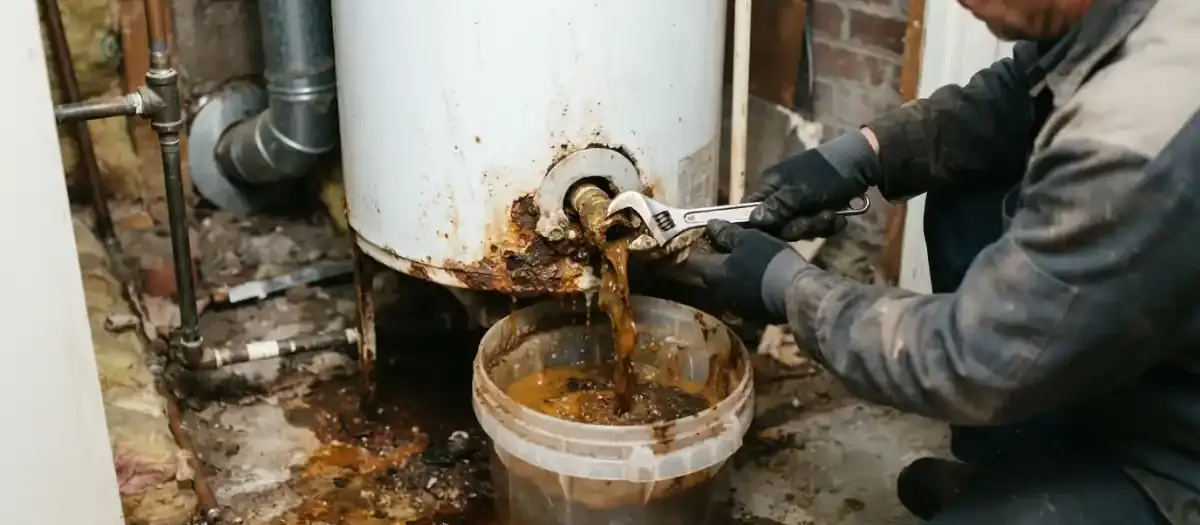
- Rust-colored hot waterRust in hot water only suggests the tank interior or the anode rod is failing.
- Moisture or rust at the baseA weeping seam rarely stops on its own. Replace before it floods.
- Rumbling or poppingSediment bakes on the bottom and the tank works harder.
- Hot water runs out fasterA thick sediment layer takes up space and insulates the water from the burner.
- Repeated repairsTwo or three repairs in a year usually mean the tank is wearing out.
Why South Florida heaters can age faster
Palm Beach Gardens receives about 66 inches of rain a year and stays humid for much of it. A heater in a garage or an outdoor closet sits in that humidity, and fittings and the tank bottom corrode earlier than they would in a dry climate.
Heaters in tight interior closets have a different problem. A small leak drips into the drain pan, goes unnoticed and slowly rots the floor. Checking the pan every few months is a cheap habit.
Local water and what it means for your heater
Seacoast Utility Authority's 2025 water quality report says its water is treated with nanofiltration and low-pressure reverse osmosis at the Hood Road plant and carries chloramine averaging 3.7 ppm. The report lists no hardness figure.
For a heater, that means we cannot assume heavy scale in your tank. Test your tap or ask the utility before assuming sediment is the cause of your hot water problem.
Living in the village next door? See our emergency plumber page for North Palm Beach.
Source type: Seacoast Utility Authority 2025 consumer confidence report.
Repair or replace: a quick guide
| Situation | Usually repair | Usually replace. |
|---|---|---|
| Tank under ten years, part failed | Yes | No. |
| Leak from the tank body | No | Yes. |
| Tank over ten years, major part failed | Maybe | Often. |
| Rusty water, older tank | No | Yes. |
| Pilot or thermostat only | Yes | No. |
How to extend the life of your heater
Flush the tank once a year to remove sediment. Test the temperature and pressure relief valve by lifting the lever briefly, with a bucket below. Check the anode rod every few years, because it is the part that is designed to corrode before your tank does.
Set the thermostat no higher than needed. Higher settings speed scale and wear. If you are going away for long periods, switch the heater to vacation mode or off.
What replacement involves
A like-for-like swap is usually a half-day job. We drain the old tank, set the new one on a proper pan, connect the lines and relief discharge, test venting and show you the shutoffs. See water heater replacement for the full walk-through.
If the heater has failed at night, water heater repair and the 24/7 line can get you hot water faster than waiting for a store to open.
If you are weighing a different type
Replacing a tank is a good moment to ask about hybrid or tankless units. A tankless unit saves space and offers continuous hot water, while a hybrid heat pump tank uses less electricity. Each has trade-offs in cost, venting and maintenance, covered on our tankless water heater page.
Reading the data plate
Every tank carries a label with the model number, serial number, capacity and recovery rating. The serial often starts with a letter for the month and two digits for the year. A tank labeled with a year ten or more years back deserves a plan, even if it still heats well today.
Photograph the label and keep it with your home records. When you call about a problem, the label tells us the fuel, the size and whether parts are still made, which saves a trip.
A yearly five-minute check
- Look at the floorCheck the pan and the floor around the tank for damp spots or rust stains.
- Touch the pipesA hot cold-water inlet pipe can point to a failing check valve.
- Lift the relief leverDo it briefly over a bucket. Water should flow and stop. If it dribbles afterward, the valve may need replacing.
- ListenPopping and knocking mean sediment has built up.
- Note the dateWrite the next check on the tank with a marker.
Quick answers
Eight to twelve years is a common range for tank units, depending on use and conditions.
Yes. The serial number on the data plate usually encodes the manufacture date.
It depends on type and installation. We give a clear price before work starts.
Not if the leak is at the tank body. A leaking fitting or valve often can be repaired.
If water is leaking, yes. Our 24/7 line at (561) 448-8545 is open at all hours.
The utility's 2025 report lists no hardness figure, so we cannot say. Flushing a tank and checking the sediment tells you more than a guess, and a tap test gives a number.