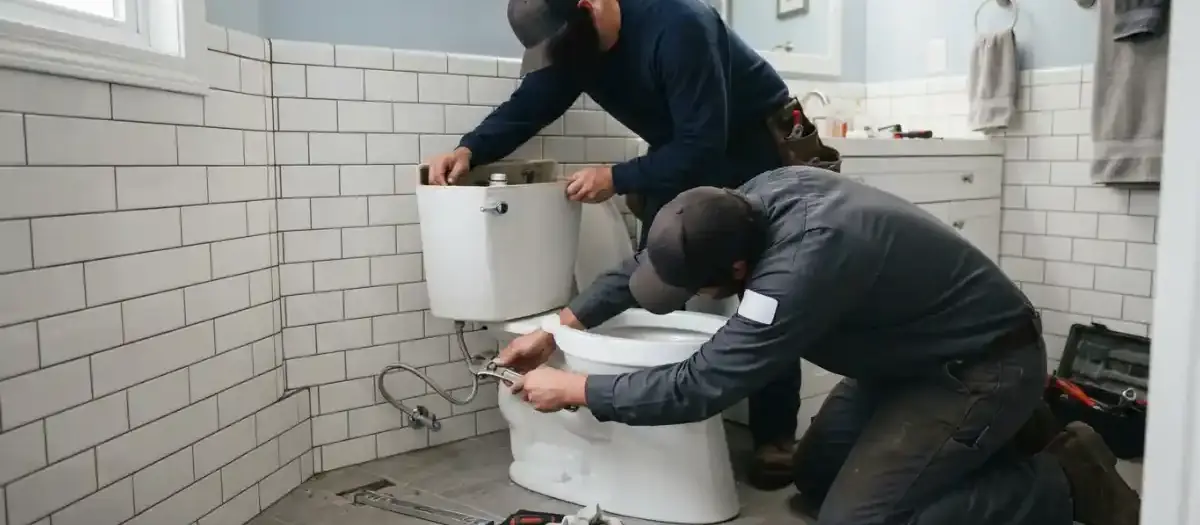
Toilet overflowing: stop it now
An overflowing toilet pours wastewater onto the floor, and the water is unsanitary. The quick action is to cut the refill and stop flushing.
If other fixtures are also slow, the main line may be involved.
- Lift the tank lid and push the flapper down, or close the supply valve behind the toilet by turning it clockwise.
- Stop flushing and ask others in the house to stop running water.
- Use towels to contain the water and keep children and pets away.
- Call the 24/7 line and tell us if other fixtures are also slow.
If a toilet and a shower back up together, the cause is likely the main line. Read about sewer line cleaning.
Common toilet problems
- Constant runningA worn flapper or fill valve lets water leak into the bowl. Chloramine-treated water can wear rubber parts over time.
- Weak flushClogged rim jets, a low tank level or a partial blockage.
- Leak at the baseA failed wax ring or loose closet bolts.
- Tank sweating or leakingCondensation, loose tank bolts or a cracked tank.
- Wobbling toiletLoose flange or bolts, sometimes a rotted floor.
Repair or replace
| Condition | Repair | Replace. |
|---|---|---|
| Worn flapper or fill valve | Yes | Not needed. |
| Leak at the base | Reset with a new seal | If the flange or floor is damaged. |
| Cracked bowl or tank | No | Yes. |
| Repeated clogs from an old model | Possible | Often smarter. |
If the toilet is not the problem, see drain cleaning.
Installing a new toilet
A new toilet install starts with a check of the flange and the floor. A flange that sits too low or a rotted subfloor needs repair first. We set the toilet on a new wax ring or sealing gasket and tighten the bolts evenly.
Rough-in distance, the measure from the wall to the drain center, decides which toilets fit. Most are twelve inches but some are ten or fourteen. We measure before you buy. Federal standards limit new toilets to 1.6 gallons per flush, and WaterSense labeled models use 1.28 gallons or less.
Toilet running or leaking?
Call and we will diagnose it on the visit.
Toilets in Palm Beach Gardens homes
Seacoast Utility Authority tells customers not to flush wipes, even those labeled flushable, because they clog sewer lines and damage pumps. That advice applies to your own toilet and drain, where wipes are one of the most common causes of repeat clogs.
Many local homes have slab floors, so a leak at the base may be seeping into the slab rather than showing as a puddle. A toilet that rocks, or a stain around the base, deserves a look.
How a toilet visit proceeds
Stop the water
We close the supply and drain the tank.
Diagnose
We check the flapper, fill valve, flange and seal.
Repair or reset
We replace worn parts or reset with a new seal.
Test
We flush repeatedly and check for leaks.
What affects toilet repair cost
A small part and a full replacement are very different jobs.
Questions we hear most
Yes. The 24/7 line at (561) 448-8545 is answered at all hours and we dispatch the same day when a slot is open.
A worn flapper or fill valve is the usual cause. Both are replaced in a short visit.
Yes. A bad seal can soak the subfloor over time. Do not ignore it.
Yes, if it fits your rough-in. We confirm before you buy.
The toilet may be old or the line may be restricted. See drain cleaning.
Yes. A rocking toilet can break its seal and leak.